
Plug a standard Bluetooth data connector into a 2025 KTM 300 XC-W TBI, ask for live data, and it says nothing. Not “no”, just an empty list. We spent a few days finding out why, and then a way around it. This is the working report.
The short version: the bike answers questions about fault codes and identity and flatly refuses live engine data. But the engine computer is not quiet. It shouts its own status onto the bus 20 times a second whether anyone asks or not. So we stopped asking and listened.
Getting on the bus
- The bike’s diagnostic plug is a clear six-pin KTM connector. It is not the red Euro 5 six-pin; they do not mate.
- You need a 6-pin to 16-pin diagnostic cable that does CAN. A K-line-only cable is useless here.
- We use a Bluetooth LE data connector because iPhones refuse the cheap Bluetooth Classic ones.
- The engine computer is a Vitesco M4C on CAN, 11-bit identifiers, 500 kbit/s.
What it will answer
| Ask | Reply |
|---|---|
| Stored and pending fault codes | Yes. One stored code on day one: P0107, manifold or barometric pressure circuit low |
| Identity (VIN, calibration, unit name) | Yes |
| Standard live data (mode 01) | An empty list. Nothing to poll |
The app does not clear codes on this bike.
One more quirk: the socket’s power is switched by a relay that drops a few seconds after the engine stops. Key on, engine off, the data connector gets nothing. The engine has to be running.
So we listened
Passive capture, 20 seconds, engine idling. We send nothing to the bike. No security access, no unlocking. The frames are not encrypted or authenticated, so reading them circumvents nothing.
Result: 2,821 frames, five identifiers, zero errors.
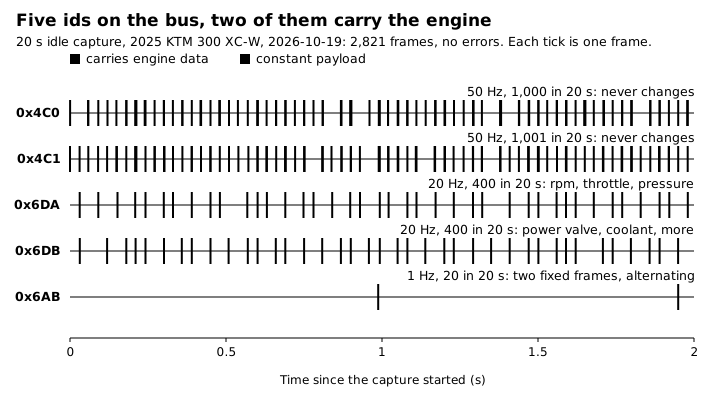
Two ids tick at 50 Hz and never change a bit. One ticks once a second. The two at 20 Hz, 0x6DA and 0x6DB, are the engine. Data: the 20 s idle capture, 2026-10-19.
Now the detective work. Take the very first 0x6DA frame of that capture:
1c 54 28 84 28 21 38 e0
Bytes 0 and 1 read as one big-endian number, divided by 4: 0x1c54 = 7252, 7252 / 4 = 1813. An idle for a two-stroke. How do you prove a number is rpm when the bike’s own dash will not tell you?
The audio trick
A single-cylinder two-stroke fires once per revolution. So the exhaust pulses at rpm / 60 hertz, and a phone microphone can hear it. No wiring, no reference gauge, a completely independent witness.
We recorded the exhaust at idle (17.7 s of audio next to the 20 s of bus capture), took the loudness envelope of the sound, and looked for the pulse rate.
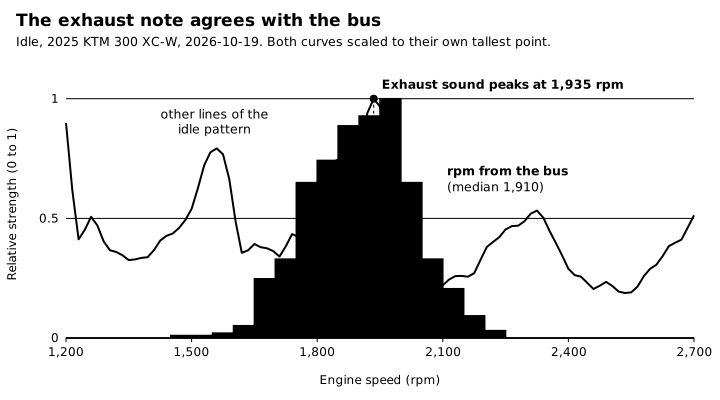
The exhaust note peaks at 1,935 rpm. The bus says a median of 1,910, wandering between 1,470 and 2,230 as a two-stroke idle does. Both curves are scaled to their own tallest point.
The check on the day tracked the pulse rate with autocorrelation and matched within a few percent. Tracked in 1.5-second windows the sound is 4 percent off the bus on average, which is what a lumpy idle gives.
The other bumps are the idle exhaust repeating a pattern 6.5 times a second, so the spectrum shows a comb of lines; the firing rate sits at the fifth one.
Rpm is verified.
The valve that followed the revs
0x6DB byte 1 looked like fuel injection quantity. On a cold start session on 2026-10-20 we did three full-throttle blips and three slow roll-ons to find out.
If it were injection, it would collapse the instant the throttle closed. It did not. It stayed high for a full second after the throttle closed, and fell only as the revs fell back through 5,000.
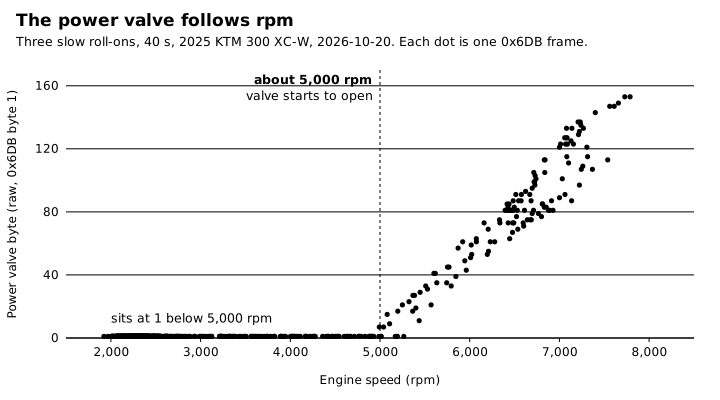
It sits at 1 until 5,000 rpm, then climbs with rpm. Data: the three roll-ons, 799 frames, 2026-10-20.
That is not fuel. It is the electric exhaust power valve, the one the repair manual calls the exhaust control actuator, whose end stops the ECU learns. So the byte is a raw position between two learned stops, not a percentage. Verified as the power valve.
The throttle that wrapped around
0x6DA byte 2 reads exactly 40 at closed throttle, every time. On the 10-20 blips it went up to 253 and, on snap closures, undershot to 1 for a frame or two. We wrote that down as an oddity.
Five days and a 2.5 hour ride later, 76,855 engine-running frames gave a very different picture.
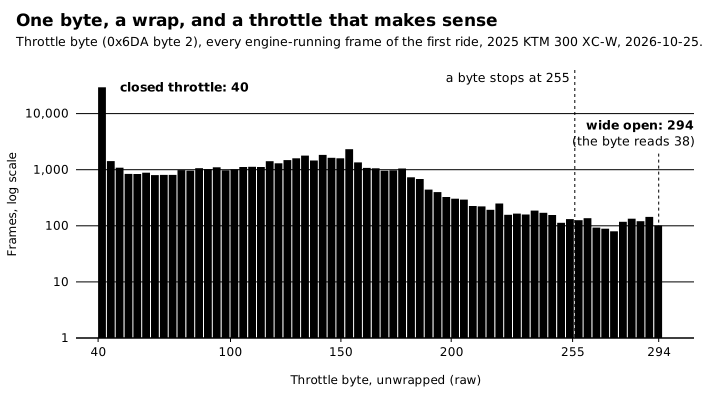
Green is the byte as read. Copper is the same byte when it reads below 40, shifted up by 256. Data: the 2025 bike, all engine-running frames on the 2026-10-25 ride.
The “undershoot” was not an undershoot. A byte stops at 255, wide open is bigger than that, and it rolls over. The values 1 to 38 turn up in 1.5 percent of frames, averaging 6,000 rpm, and never at idle. Add 256 and the whole ride lines up from 40 (closed) to 294 (wide open), on both bikes. Algebra: throttle % = (raw - 40) / (294 - 40), with raw + 256 when the byte reads under 40.
Until we found this, wide open read as zero percent. Throttle is decoded.
Is that a temperature?
0x6DB byte 0 climbs from a low number to a plateau as the bike warms up. It looks like coolant, in degrees Celsius, and the dash of this bike shows no temperature to compare with.
So we asked the data a different question. If the byte is degrees, a warm-up should follow a heating curve:
T(t) = T_inf - (T_inf - T_0) * exp(-t / tau)
We fitted that to the first 200 seconds of a cold start, ambient 24 to 26 C, and nothing after. Three numbers came out: an asymptote of 108, a time constant of 257 seconds, and a residual of 0.4 degrees, the size of the byte’s own rounding.
Then the test: run the curve backwards to the moment the engine started, 70 seconds before the first frame.
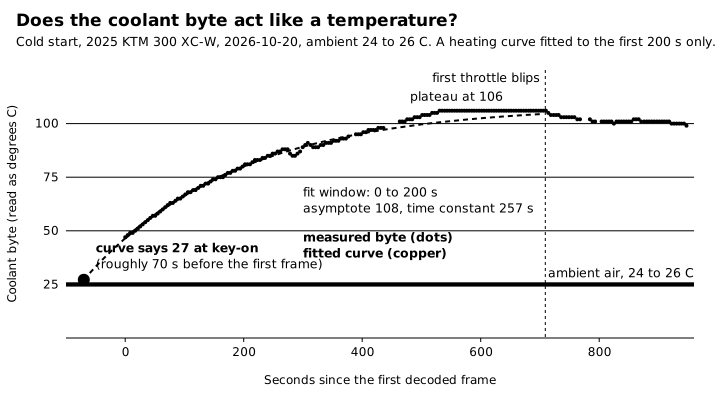
The curve says 27 at key-on, ambient was 24 to 26. Fitted on the first 200 seconds only; the dashed parts are extrapolation. Data: the 2026-10-20 cold start.
It lands within a couple of degrees of the air temperature. With a big offset in the scale, it would not. And the later behaviour is physical too: a plateau at 106 at idle, then a fall to 100 or 101 after the first throttle blips, and the radiator fan seen running a few minutes later.
Coolant is decoded.
Other fields we found
- Barometric pressure (0x6DA bytes 6 and 7):
((b6 & 0x7F) << 4) | (b7 >> 4), 910 to 956 hPa on the ride. Against standard-atmosphere pressure for the GPS altitude it correlates at -0.99 on both bikes. - A second throttle channel (0x6DA byte 3),
1.24 * throttle + 82at steady state. - A field shaped like an ignition map (0x6DB bytes 3 and 4): same on both bikes, falls with throttle and rpm. Raw values.
- A counter that only goes up (0x6DB byte 6): steps up by one notch now and then, on both bikes, never back. Engine hours.
- A second slow temperature (0x6DB byte 7): behaves like intake air. Raw values.
What the bike does not say
No injection time or fuel quantity anywhere in the broadcast; we looked at every moving bit. No gear, no rear wheel speed, no clutch state. And the check engine lamp state is not readable.
First ride day
On October 25 two of us rode two KTM 300 XC-W bikes, a 2025 and a 2026, each with its own data connector and its own iPhone, for two and a half hours.
| 2025 bike | 2026 bike | |
|---|---|---|
| Distance | 21 miles | 21 miles |
| GPS points | 9,011 | 9,090 |
| Data connector connections | 37 | 29 |
| Engine running | 3,875 s (65 min) | 5,416 s (90 min) |
The 2026 bike read the same values as the 2025, so the 2026 model year went into the profile.
The ride found a problem. On the 2025 bike’s phone the link to the data connector dropped, and engine data stopped for 16 minutes until the bike was restarted. That led to a fix in the app: it now tries to recover on its own and, if needed, tells you to power-cycle the bike.
Why this matters for a rider
Engine speed, throttle, power valve and temperature go into your ride record beside the GPS track and the battery readings. Then your own assistant can answer “how long did I spend near the redline on that ride?” from your own data.
The bike is on the KTM 300 XC-W page. How the pieces fit together is at how it works, the whole product is at /moto, and why we build it is in our story. Life Lever Moto is an iPhone app and is not in the App Store, so it is handed out by invite.
KTM and Triumph are trademarks of their owners. lifelever is not affiliated with or endorsed by them.