
For the curious: you do not need any of this to ride.
The short version: the Sprint ST 955i has a Sagem MC1000 engine computer on a single-wire K-line. It wakes up only with a slow 5-baud init, then answers the standard diagnostic channel: live values, stored and pending fault codes, and clearing. It has no VIN. The bike is older than the diagnostic mandate, and we found all of this by trying. Everything here was read from a real 2004 Sprint ST, first with a USB data connector on a cable and then with a Bluetooth LE data connector.
Back to all bikes.
At a glance
| Item | What we found | Status |
|---|---|---|
| Bike | Triumph Sprint ST 955i, profile covers 1999 to 2004 | 2004 verified |
| ECU | Sagem MC1000 | Identified |
| Plug | 16-pin, standard car shape (SAE J1962), under the seat near the battery | Shape verified |
| Bus | K-line, ISO 9141-2, 10400 baud, 8N1 | Verified |
| Init | 5-baud slow init. Fast init is refused | Verified |
| Standard live data (mode 01) | Yes, 15 supported PIDs | Verified |
| Fault codes | Stored (mode 03) and pending (mode 07) | Verified |
| Clearing codes | Mode 04 worked on the bike | Verified |
| VIN | None. No mode 09 | Verified |
| Own KWP2000 dialect | ECU address 0x12, tester 0xF1 | Slow init reaches it |
| Battery | Lithium | Known |
The plug and the key
The connector is a 16-pin socket shaped like a car’s diagnostic port, and a standard data connector plugs straight in; both the USB one and the Bluetooth one did. It sits under the seat near the battery, parked on a plastic tab when not in use. On 2026-09-20 the socket gave 12.8 V on pin 16. Check the pinout before wiring anything to the other pins.
For code reads: ignition on, kill switch on RUN, engine off. We read live data with the engine running, at idle, at 3,000 and at 4,400 rpm.
The language: K-line, slow init
The bike’s ECU does not respond to the fast wake-up pulse. On 2026-09-20 we tried fast init and got a bus init error at all four addresses we tried (0x12, 0x10, 0x11 and the functional 0x33). Slow init worked: the data connector sends the ECU’s address at 5 baud, and the ECU answers.
With the data connector on automatic it settled on ISO 9141-2, and the bike answered a standard request:
request   01 00
reply     48 6B D1 41 00 BE 1E 90 11 42
That is mode 01, PID 00, “which live values do you have?” The header says the answer came from address 0xD1 and the last byte is a checksum we verified by hand. The four bytes BE 1E 90 11 are the list of supported PIDs.
One quirk with the Bluetooth data connector: on ISO 9141-2 the first slow init always errors and the second succeeds, on all four separate connections we tried. The data connector retries once after 300 ms, so you do not see it, but it is there.
Standard PIDs
The ECU lists 15 supported PIDs: 00 (the list itself), 01, 03, 04, 05, 06, 07, 0C, 0D, 0E, 0F, 11, 14, 1C and 20. The app asks for these:
| Value | PID | Unit | How often |
|---|---|---|---|
| Engine speed | 0x0C | rpm | Every pass |
| Throttle position | 0x11 | Percent | Every pass |
| Vehicle speed | 0x0D | km/h in the bike, mph in the app | Every pass |
| Calculated engine load | 0x04 | Percent | Every second |
| Coolant temperature | 0x05 | Degrees C, F in the app | Every 5 seconds |
| Intake air temperature | 0x0F | Degrees C, F in the app | Every 5 seconds |
| Short-term fuel trim, bank 1 | 0x06 | Percent | Every 2 seconds |
| Long-term fuel trim, bank 1 | 0x07 | Percent | Every 10 seconds |
| Ignition timing advance | 0x0E | Degrees | Every second |
| Oxygen sensor 1 (lambda) | 0x14 | Volts | Every 2 seconds |
| Monitor status and check engine lamp | 0x01 | Bit map | When codes are read |
The list also holds PID 03 (fuel system status), 1C (which diagnostic standard the ECU claims) and 20 (the next range); the app does not show those.
On the bike these read as expected. Closed loop started from 65 C and the oxygen sensor was swinging, which is what a working lambda loop looks like. Charging voltage sat flat at 12.9 to 13.6 V across idle, 3,000 and 4,400 rpm.
What the standard channel does not give: an injector pulse, or anything manufacturer-specific.
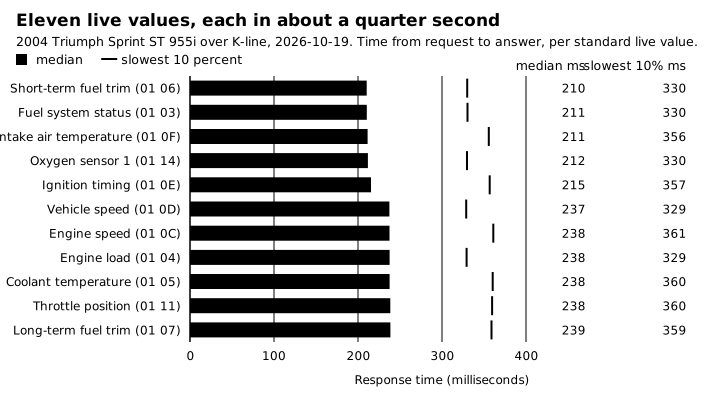
Each of 11 live values answers in 210 to 240 ms over K-line, so one pass through all 11 takes about 2.7 seconds.
Modes and codes
| Mode | What it does | Answers |
|---|---|---|
| 01 | Live values | Yes |
| 03 | Stored fault codes | Yes |
| 07 | Pending fault codes | Yes |
| 04 | Clear codes | Yes, confirmed on the bike |
| 09 | VIN and identification | No |
On first contact the check engine lamp was lit, with the fuel tank off the bike. The scan read five stored codes: coolant and intake temperature circuits, fuel pump relay, and fuel level sender. All five fit connectors left unplugged with the key on. The codes were cleared and did not return. On 2026-10-19 the lamp was off and nothing was stored.
The Triumph does not flash a code on its lamp, so reading the code takes a scan tool. Codes stay in memory until a tool clears them, even after the lamp goes out. The app can read codes, and on this bike it can clear them too, after you confirm each time; it reads them again afterward to show what is left.
Codes reported for this ECU family
These come from owner forums and tool users, not from a Triumph service manual.
| Code | Meaning |
|---|---|
| P0031 | O2 sensor 1 heater circuit, low input |
| P0113 | Intake air temperature circuit, high or open |
| P0135 | O2 sensor heater circuit |
| P0230 | Fuel pump relay circuit |
| P0335 | Crankshaft position sensor circuit |
| P0351, P0352, P0353 | Ignition coil 1, 2, 3 circuit |
| P0463 | Fuel level sensor circuit, high input |
| P1116 | Coolant temperature sensor circuit, short or open |
| P1231 | Fuel pump relay, open or short to ground |
| P1335 | Crankshaft position sensor, incorrect signal pattern |
| P1351, P1352, P1353 | Ignition coil 1, 2, 3, open or short to battery |
| P1552 | Cooling fan circuit |
No VIN
This ECU gives no VIN, over either channel. The standard path has no mode 09, and the bike’s own protocol has none. So the app cannot recognise the bike from the bus the way it does the KTM. Instead it uses an id the phone makes when you add the bike, and that id stays with your rides.
The native channel
Besides the standard channel, the Sagem speaks its own KWP2000 dialect, on ECU address 0x12, tester address 0xF1. The same slow init reaches it. On 2026-10-19 the Bluetooth data connector took the init and returned no data for the native requests; the USB data connector is the one that worked on 2026-09-20. Everything the app shows comes from the standard values.
Cheap clone data connectors can get the timing of K-line fast init wrong. That applies to fast init, not slow.
The battery lesson
The bike has a lithium battery. On 2026-10-19 the lithium battery went flat during the first start attempt, after 25 to 30 minutes of key-on. The diagnostic socket is live whenever the key is on, so the data connector stays powered for as long as the key is.
That is why Life Lever Moto has a battery watch. It reads the voltage at the plug, keeps the readings, and looks for the patterns of a battery in trouble. If you leave the key on with a data connector in the plug, watch the clock. More about the hardware in Phones.
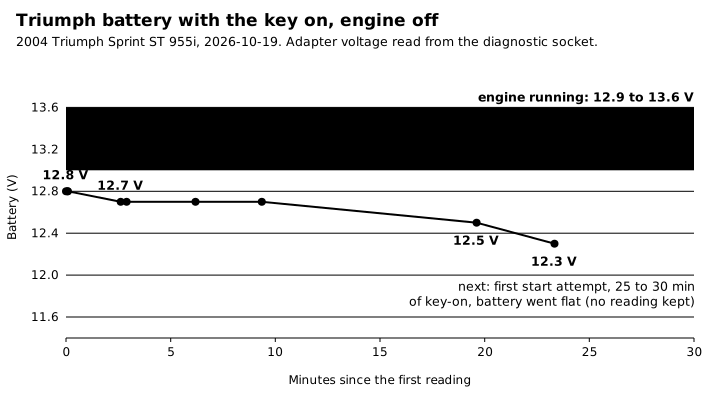
Key on, engine off: the Triumph’s battery fell from 12.8 to 12.3 V in 23 minutes. Running, it reads 12.9 to 13.6 V. This is why Moto watches the battery.
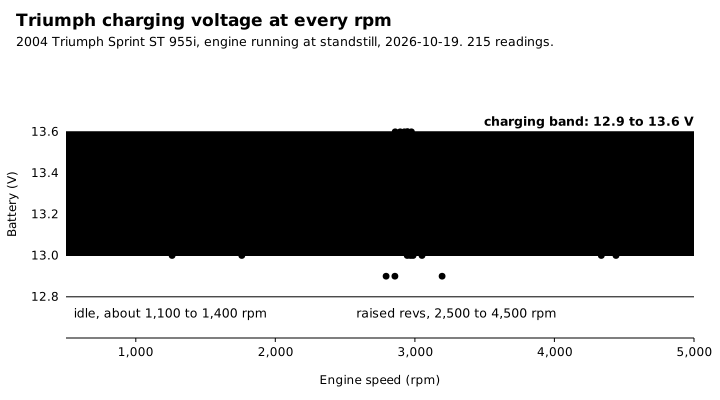
Charging voltage holds 12.9 to 13.6 V from idle to 4,500 rpm, with no trend: the charging system is healthy.
What it is not
The Moto app does not flash or tune the bike. It reads, and it clears codes only when you tell it to, in the app after a confirm.
KTM and Triumph are trademarks of their owners; lifelever is not affiliated with them.